Some of my favourite beaches are the ones you have to make an effort to reach. There's something about leaving the car behind, walking for a while and eventually seeing a beach appear below you that makes arriving there feel different. They're usually quieter, less developed and, because everyone who gets there has had to put in a bit of effort, somehow more rewarding.
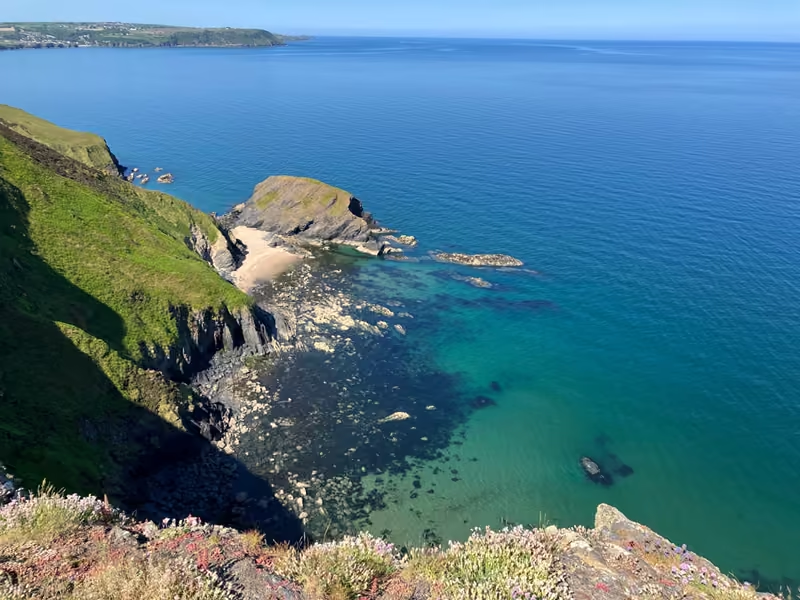
Traeth Bach, a small, secluded beach on the Ceredigion coast of West Wales, is exactly that sort of place.
We've always known it by another name, Perspiration Bay. You won't find that on Google Maps; a friend christened it that years ago because of the effort involved in walking there from Llangrannog. After tackling the ups and downs of this stretch of coastline, you'll understand why.
We travelled from our home in South Wales to Llangrannog for a family day out, with Traeth Bach as our destination.
Where is Llangrannog?
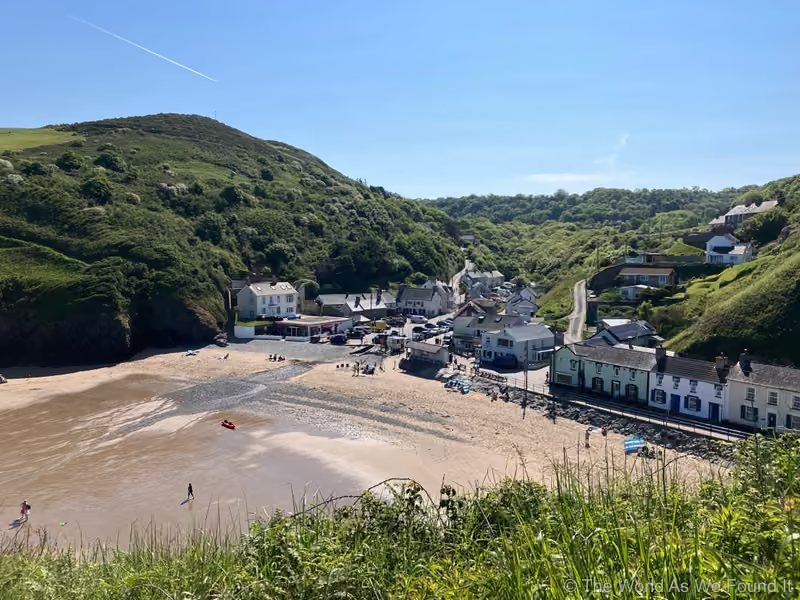
Llangrannog is a small seaside village on the Ceredigion coast of West Wales, tucked into a narrow valley where the hills meet Cardigan Bay.
Houses, pubs and cafés cluster around a sandy beach, with steep green cliffs rising on either side. One of its most recognisable features is Carreg Bica, the large rock rising from the sand on Llangrannog beach. There's even a local legend attached to it: Carreg Bica is said to be the tooth of a giant called Bica, who suffered from toothache and spat the troublesome tooth onto the beach.
Llangrannog is popular with families, surfers and walkers, and the Wales Coast Path passes directly through the village. Despite feeling fairly remote, it's perfectly possible to visit for the day from South Wales. That's part of the appeal for us: it's close enough for a day trip but far enough west to feel like you've gone somewhere.
Driving to Llangrannog
Llangrannog lies roughly between Aberystwyth and Cardigan, although it's considerably closer to Cardigan and tucked away from the main A487 coast road.
It's about 30 miles south of Aberystwyth, a drive of around 50 minutes to an hour. Cardigan is around 10–12 miles away, while Swansea is about 58 miles away, typically around an hour and a half by car. From Cardiff, allow roughly two hours, depending on traffic and exactly where you're travelling from.
For much of the journey, getting there is straightforward. The A487 is the main road running through this part of Ceredigion, linking Aberystwyth, New Quay and Cardigan, but once you turn off for Llangrannog the journey becomes more interesting.
The roads quickly become smaller and more rural, winding through the countryside before narrowing considerably as you approach the coast. Some sections are effectively single-track, with high hedges, blind bends and limited places for two cars to pass. If you're used to driving on rural Welsh roads, there's nothing particularly unusual about them, but if you're not, take your time around the blind bends and be prepared to reverse to a passing place if necessary.
The final approach is part of Llangrannog's charm. Rather than arriving along a big coastal road, you descend through a narrow valley towards the sea, with the road becoming enclosed by the hills and village buildings before eventually bringing you down near the beach. On a sunny summer weekend, with cars travelling in both directions along those little lanes, a bit of patience may be required.
Parking in Llangrannog
There are a couple of options for parking in Llangrannog. The most convenient is the small paying car park close to the seafront, which has only around 38 spaces, so I wouldn't rely on finding a space there during busy periods. We arrived early and managed to park there.
The car park is privately operated and monitored by ANPR cameras. Current parking conditions require payment within 10 minutes of entering. The machine accepts coins and cards, and you can also use JustPark, although mobile reception in Llangrannog can be patchy. Parking arrangements and charges can change, so read the signs when you arrive.
If the seafront car park is full, there is a large free parking area further up the village, roughly a ten-minute walk from the beach. A community park-and-ride also operates from the upper parking area during the peak season, although the service is seasonal.
What is the Wales Coast Path?
The walk from Llangrannog to Traeth Bach follows part of the Wales Coast Path, which opened in 2012 and follows the Welsh coastline for around 870 miles (1,400 km), from the border with England near Chester in the north all the way around to Chepstow in the south-east.
Wales was the first country in the world to establish a continuous waymarked walking route around its entire coastline, although you obviously don't need to walk all 870 miles to enjoy it. Around Llangrannog, the path follows the Ceredigion cliffs, repeatedly climbing and dropping into small valleys and coves.
That's worth remembering when looking at the distance on a map, because a mile along this coastline isn't necessarily an easy mile.
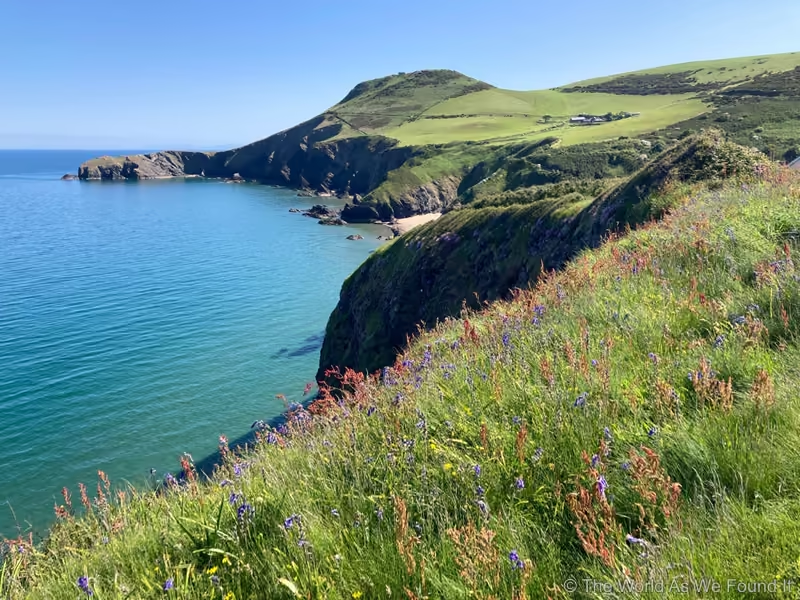
Pick a good day if you can
Spring can be a fantastic time to explore this part of the Welsh coast if you get the weather. West Wales gets plenty of rain, and when you're travelling some distance to get here, that makes planning too far in advance difficult.
For us, this is more the sort of trip to do when you see a genuinely good day in the forecast and decide to go, because when you get one, it's definitely worth the journey. In spring, the countryside is intensely green and there are wildflowers along the path and across the clifftops.
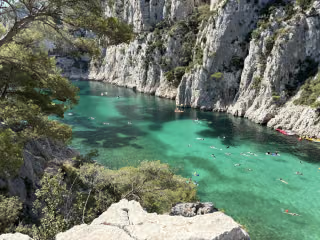
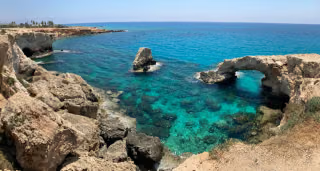
The colour of the water can be fantastic too. On a bright day, the sea along this part of Cardigan Bay can be a mixture of blue, turquoise and green, and seen from high above on the coast path, with green cliffs and spring flowers in the foreground, it can look spectacular. If you have the flexibility, I'd save this walk for good weather.
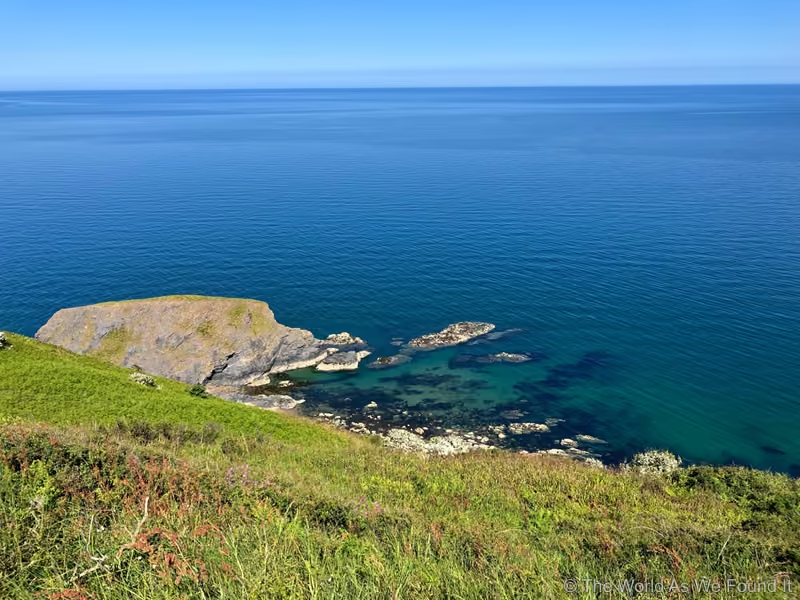
Keep looking out to sea
This stretch of the West Wales coast is particularly good for bottlenose dolphins and grey seals. Cardigan Bay supports a resident population of bottlenose dolphins, and the high cliffs give you a good vantage point for spotting them.
Sometimes all you'll see is a distant fin breaking the surface, while on other occasions dolphins can be seen travelling or feeding offshore. There are no guarantees, but it's worth stopping occasionally and scanning the water rather than concentrating entirely on the path.
Grey seals are another familiar sight along this coastline, particularly around Traeth Bach itself.
Hiking from Llangrannog to Traeth Bach
From Llangrannog, we picked up the Wales Coast Path and headed south towards Penbryn. Traeth Bach lies roughly three-quarters of a mile along the coast, but don't judge the walk purely by the mileage, as this isn't a flat promenade.
The path climbs and descends with the coastline, and the official description of the longer Llangrannog-to-Penbryn section calls it rugged and testing. It's also where our nickname for Traeth Bach comes from. Years ago, a friend christened it “Perspiration Bay” because of the effort involved in getting there, and the name stuck.
It's not an official alternative name, so if you're looking for it on a map, search for Traeth Bach.
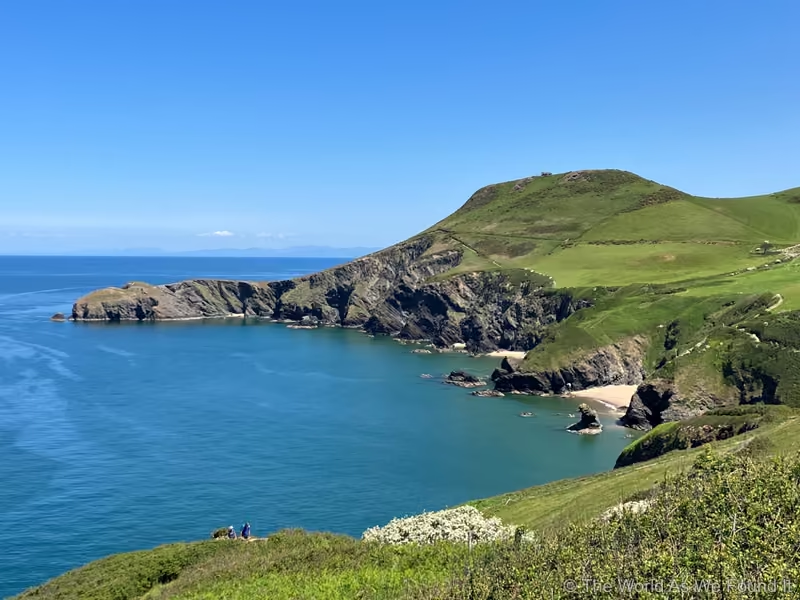
The final descent onto Traeth Bach
As the coast path descends into the small valley above Traeth Bach, it zig-zags downhill towards a stream and a small wooden footbridge. On our route, we turned right just before crossing the bridge, leaving the Wales Coast Path to follow the stream down towards the sea.
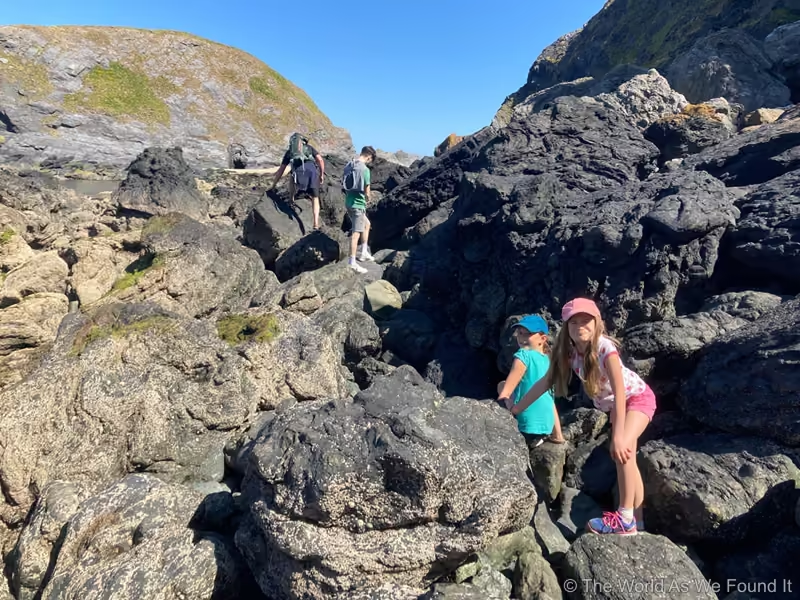
Most of the route follows a recognisable coast path, but right at the bottom it becomes considerably rougher. The final descent is really steep, and for the last few metres you're almost clambering rather than simply walking, with rocks to negotiate and places where you'll probably use your hands to steady yourself.
It's manageable, and we've done it as a family as well as previously with a large group of teenagers, but mobility is definitely an issue here. I wouldn't recommend the final descent to anyone who struggles with balance, steep ground or uneven rocky terrain. It's not suitable for pushchairs, proper footwear makes considerably more sense than flip-flops, and I'd be particularly careful if the rocks were wet.
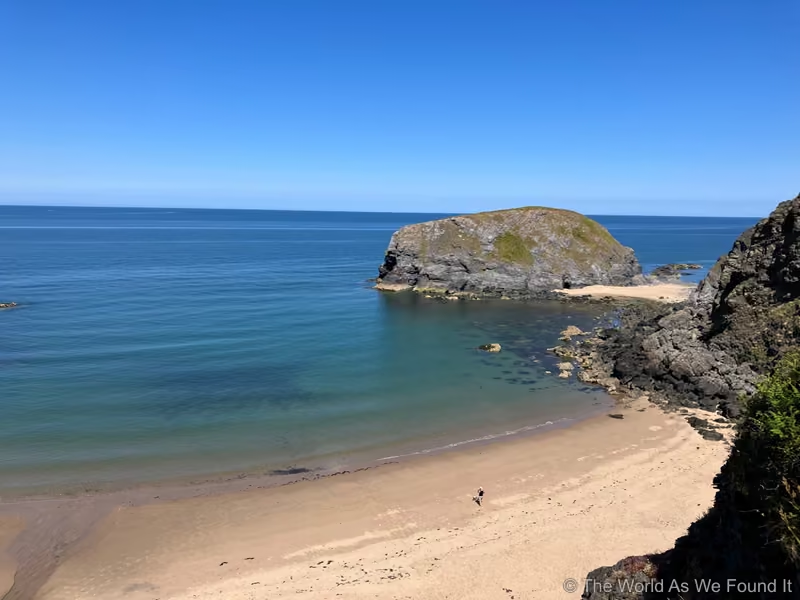
Reaching Traeth Bach
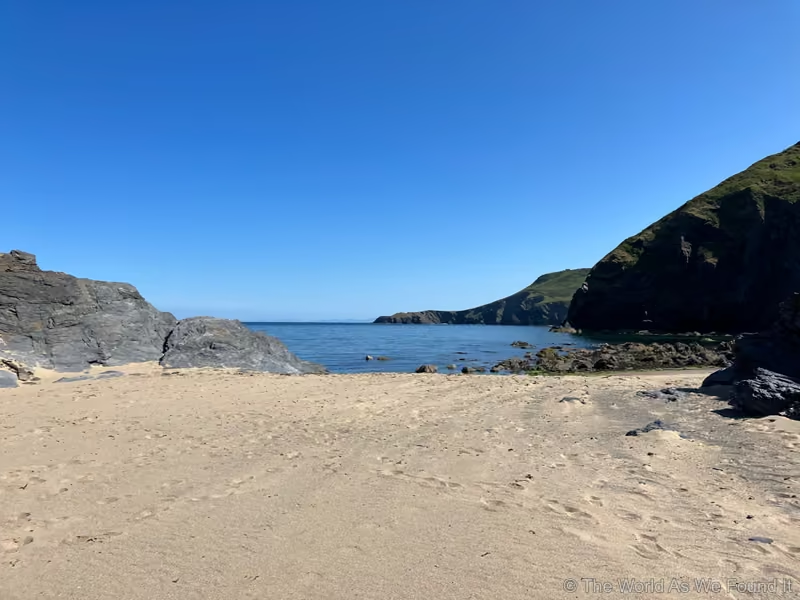
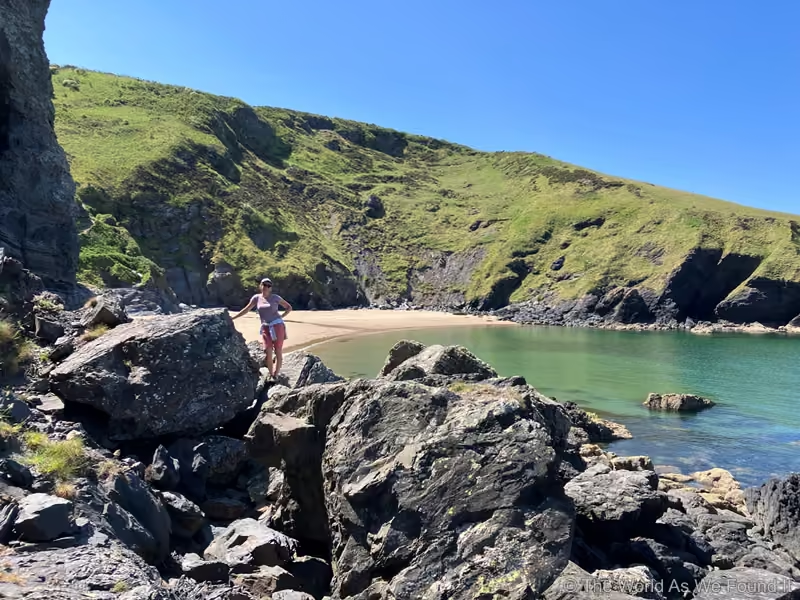
Once you're down, you can see why the beach remains relatively quiet. There's no road or car park and no row of facilities behind it, so you arrive with whatever you've carried there yourself, which is exactly what I like about it.
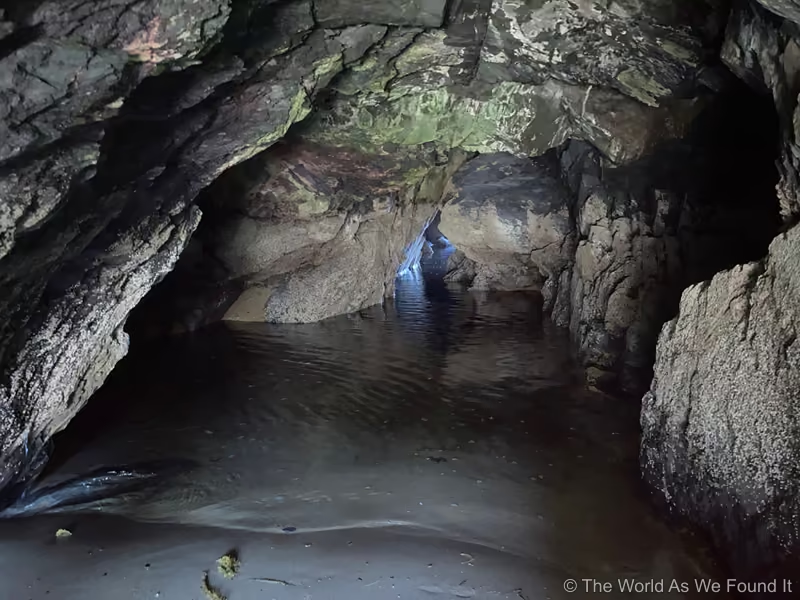
One of the features I particularly associate with Traeth Bach is the huge rock beside the beach with a large cave in it. We've visited several times over the years and have often found grey seals in or around the cave, while we've also occasionally arrived to find seals hauled out on the beach itself.
Before we went into the cave on our family visit, I'd joked with the girls that there might be a sea monster living inside, so they were already a little sheepish about exploring it.
We went farther into the cave and, once we were quite a way in, a head suddenly appeared out of the water.
The girls ran out in terror.
It looked like a seal had been swimming inside the cave. We didn't hang around long enough to get a particularly good look at it, but after my sea-monster warning, the girls certainly weren't going back in to investigate.
It's fantastic to see them here, but if there is a seal on the beach, remember that you're entering its space. Keep well back, keep dogs away and never get between a seal and the sea. They're wild animals, so there's no guarantee you'll see one, but we've been fortunate enough to encounter them here on a number of visits.
You can arrive from the sea too
Walking isn't the only way to reach Traeth Bach, as in suitable conditions it's also possible to approach from Llangrannog by paddleboard or small boat, travelling beneath the cliffs rather than looking down on them from the coast path.
It's a really cool way to arrive and gives you a completely different view of the caves, rocks and little coves along this part of the coast. This is open coastline, though, so wind, swell, currents and tides need to be taken seriously, making it an option for people with the appropriate experience and the right conditions rather than something I'd suggest doing casually.
The day 40 teenagers took over Traeth Bach
Our family walk wasn't my first visit to Traeth Bach, as several years earlier I came here while volunteering with our church youth group.
We walked from Llangrannog with around 40 teenagers, carrying food and everything we needed for a barbecue on the beach. With all that equipment coming over the coast path with us, Perspiration Bay felt like a particularly appropriate name that day.
When we arrived, there was virtually nobody else there. Apart from our group, I remember just one family with a teenage girl of about the same age as the teenagers with us.
Once we'd settled in, we suggested to the boys that we get a game of volleyball going, but nobody was interested and they were perfectly happy sitting on the beach doing nothing. We then asked the other family if they fancied playing instead, and their teenage daughter said she'd like to join us.
Suddenly, all those teenage boys who had shown absolutely no interest in volleyball a few moments earlier were extremely keen to play, and within minutes we had something approaching 15 players on each side charging around Traeth Bach. I'll leave you to draw your own conclusions about their sudden enthusiasm for beach volleyball.
It's a memory that has always stuck with me, but it also says something about Traeth Bach: we'd arrived with around 40 teenagers and found just one other family on the beach.
Is the walk suitable for children?
We've done Traeth Bach as a family, so it can make a great family hike, but I wouldn't describe it as an easy family beach walk. The coast path has some steep climbs and descents, while the final route onto the beach is particularly steep and rocky.
I'd say it's suitable for active children who are comfortable walking on uneven ground, with close supervision where appropriate. It isn't suitable for pushchairs, and I'd think carefully before attempting the final descent with very young children or anyone with restricted mobility. Remember that you also have to carry everything you want at the beach there and back.
Facilities at Traeth Bach
There are no toilets, cafés, shops or lifeguards at Traeth Bach, so use the facilities in Llangrannog and pick up whatever you need before setting off. Take enough water, particularly on a warm day, and bring all your rubbish back with you.
Do you need to check the tide?
I'd check the tide before setting off. Traeth Bach normally has plenty of usable beach, and I wouldn't describe it as somewhere that routinely disappears every time the tide comes in, but it's a relatively small cove surrounded by cliffs, so it makes sense to know what the tide is doing, particularly if an unusually high tide is forecast.
Can you continue to Penbryn?
If Traeth Bach isn't far enough, you can continue south on the Wales Coast Path and eventually reach Penbryn, another lovely beach on this stretch of the Ceredigion coast.
The complete Llangrannog-to-Penbryn section is around 2.6 miles (4 km) one way, so you can turn this into a considerably longer coastal walk. For a family day out, though, Traeth Bach makes a good destination in its own right before returning to Llangrannog the same way.
Practical information for walking to Traeth Bach
Start: Llangrannog, Ceredigion
Destination: Traeth Bach
Direction: South on the Wales Coast Path towards Penbryn
Distance to Traeth Bach: Approximately three-quarters of a mile each way
Terrain: Hilly coast path followed by a very steep, rocky final descent
Difficulty: Moderate overall, with a more challenging final descent
Accessibility: Not suitable for pushchairs and likely to be difficult for anyone with restricted mobility or poor balance
Facilities at Traeth Bach: None
Food and toilets: Available in Llangrannog
Lifeguard: None at Traeth Bach
Dogs: Permitted, but keep them under close control around livestock and wildlife, particularly seals
Best time: For us, a clear spring day is hard to beat
Before setting off: Check the weather and tide
Is Traeth Bach worth the walk?
Definitely. There's something satisfying about leaving Llangrannog behind, climbing onto the coast path with views across Cardigan Bay, walking past spring flowers with the blue-green sea below and eventually seeing a little beach tucked beneath the cliffs.
Traeth Bach isn't particularly far from Llangrannog, but the lack of road access and the effort required to reach the sand make it feel much more secluded than the distance suggests. Add the cave, the possibility of seeing seals, the chance of spotting dolphins offshore and a beautiful stretch of the Wales Coast Path, and it makes a brilliant family day out when the West Wales weather cooperates.
Although I've mostly behaved myself and called it Traeth Bach throughout this article, in our family I suspect it will always have another name: Perspiration Bay.
More of the Welsh coast
If you enjoy beaches that involve a walk to reach them, you might also like our family walk to Three Cliffs Bay on the Gower, another of our favourite coastal days out in South Wales.