Begin with the language around you
Welsh is a language of everyday life as well as poetry and history. Its Welsh name is Cymraeg. You may meet it in a conversation, a bookshop, a song or the name of a landscape. Those encounters give a visit another layer: a place becomes more than something to photograph when you begin to listen to its words.
Welsh and English both belong to the literary life of Wales. A writer’s choice of language is not a simple measure of how Welsh their work is. Reading across the two traditions reveals different histories, voices and ways of seeing the country, with translation providing a bridge between them.
A short history of Cymraeg
Welsh developed from the Brittonic language once spoken across much of Britain. Over many centuries it became a distinct language with a substantial poetic and literary tradition. Its history reaches beyond the modern borders of Wales, reminding us that today’s map is not a complete guide to the language’s earlier world.
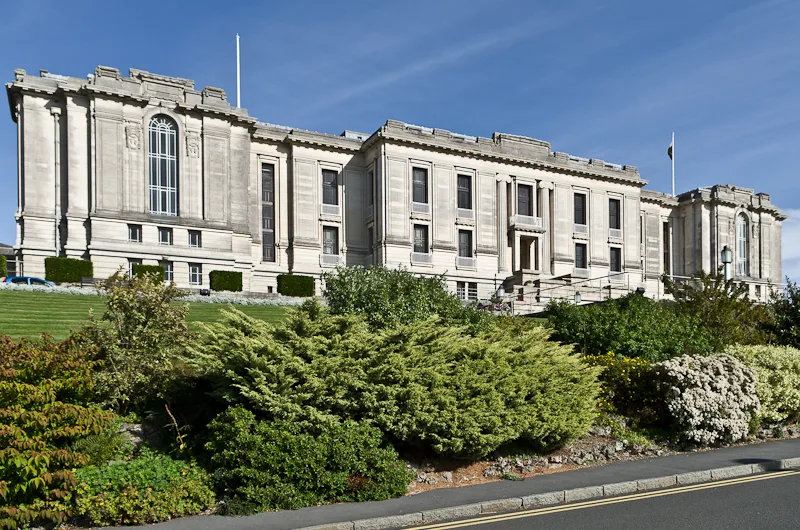
Manuscripts preserve part of that world, while the printing press helped shape another. William Morgan’s complete Welsh Bible, published in 1588, became a landmark in the history of written Welsh. The National Library’s digital exhibition explains its creation and the influence of its language. It is a useful place to begin even if religious history is not your main interest.
The language’s later story includes pressure as well as survival. The Welsh Not, used in some schools to discourage children from speaking Welsh, is one material reminder of that experience. It should not be mistaken for an identical practice in every Welsh school. Museum collections help place an object such as this in its particular historical setting.
In more recent public life, the Welsh Language (Wales) Measure 2011 gave Welsh official status. Education, publishing, broadcasting, music and adult learning all provide ways to encounter it today. The language is not simply something preserved from the past; people continue to use it to describe the present and imagine the future.
Writers to discover in Welsh
You do not need to read Welsh fluently to begin exploring its literature. Bilingual editions, translations and recordings can make the first connection. Where possible, listen to a poem in Welsh as well as reading a translation: sound is part of its craft.
Dafydd ap Gwilym
The fourteenth-century poet is an inviting starting point for medieval Welsh verse, with poems concerned with love, nature and human experience. The scholarly digital edition offers a route into the texts and their interpretation.
Kate Roberts
Roberts’s Welsh-language fiction draws readers towards lives shaped by work, family and hardship. Her short stories and the novel Traed Mewn Cyffion, available in English as Feet in Chains, offer a powerful introduction to her world.
Hedd Wyn
The poet Ellis Humphrey Evans won the 1917 National Eisteddfod chair after his death in the First World War. His family home, Yr Ysgwrn, connects the poetry with a rural community and the human losses of war.
Welsh writers working in English
The English-language literature of Wales has its own range, from the intimate life of a town to spiritual questioning and the imaginative worlds of childhood. These three names provide different starting points rather than a complete literary canon.
Dylan Thomas
Born in Swansea, Thomas made language itself part of the drama of his poems, stories and broadcasts. Under Milk Wood is a particularly rewarding work to hear, with its imagined community brought into being through voices.
R. S. Thomas
A poet and Anglican priest, R. S. Thomas wrote in English while engaging deeply with Welsh identity, rural life and faith. His association with Aberdaron offers one geographical route into his work, but the poems reach well beyond a single landscape.
Roald Dahl
Born in Llandaff, Cardiff, to Norwegian parents, Dahl is a reminder that Welsh literary connections can cross languages and family histories. Books such as Matilda and The BFG offer a very different reading journey from the poetry of the two Thomases.
A few Welsh words for your visit
A greeting or a thank-you is a manageable place to begin. Try one phrase, listen to how people say it and add another when you feel ready. Pronunciation varies across Wales; the linked learning resources are more useful than trying to force every sound into an English spelling.
| Welsh | English |
|---|---|
| Cymraeg | Welsh (the language) |
| Bore da | Good morning |
| Prynhawn da | Good afternoon |
| Noswaith dda | Good evening |
| Nos da | Good night |
| Sut mae? | How are you? / a greeting |
| Diolch | Thank you |
| Diolch yn fawr | Thank you very much |
| Croeso | Welcome / you’re welcome |
| Hwyl fawr | Goodbye |
Let the reading lead the journey
Choose one writer before trying to cover an entire literary landscape. Read a story, listen to a poem or explore a digital archive, then decide whether a place connected with that work would add to your visit. A bookshop conversation or a reading can be as meaningful as a famous address.
Aberystwyth provides a base for exploring the National Library’s resources; Swansea and Laugharne connect with Dylan Thomas; Yr Ysgwrn offers a route into Hedd Wyn’s story near Trawsfynydd. Check the relevant organisation’s current visitor information before setting out. For a different kind of encounter with Welsh words, follow them into music and the eisteddfod tradition.